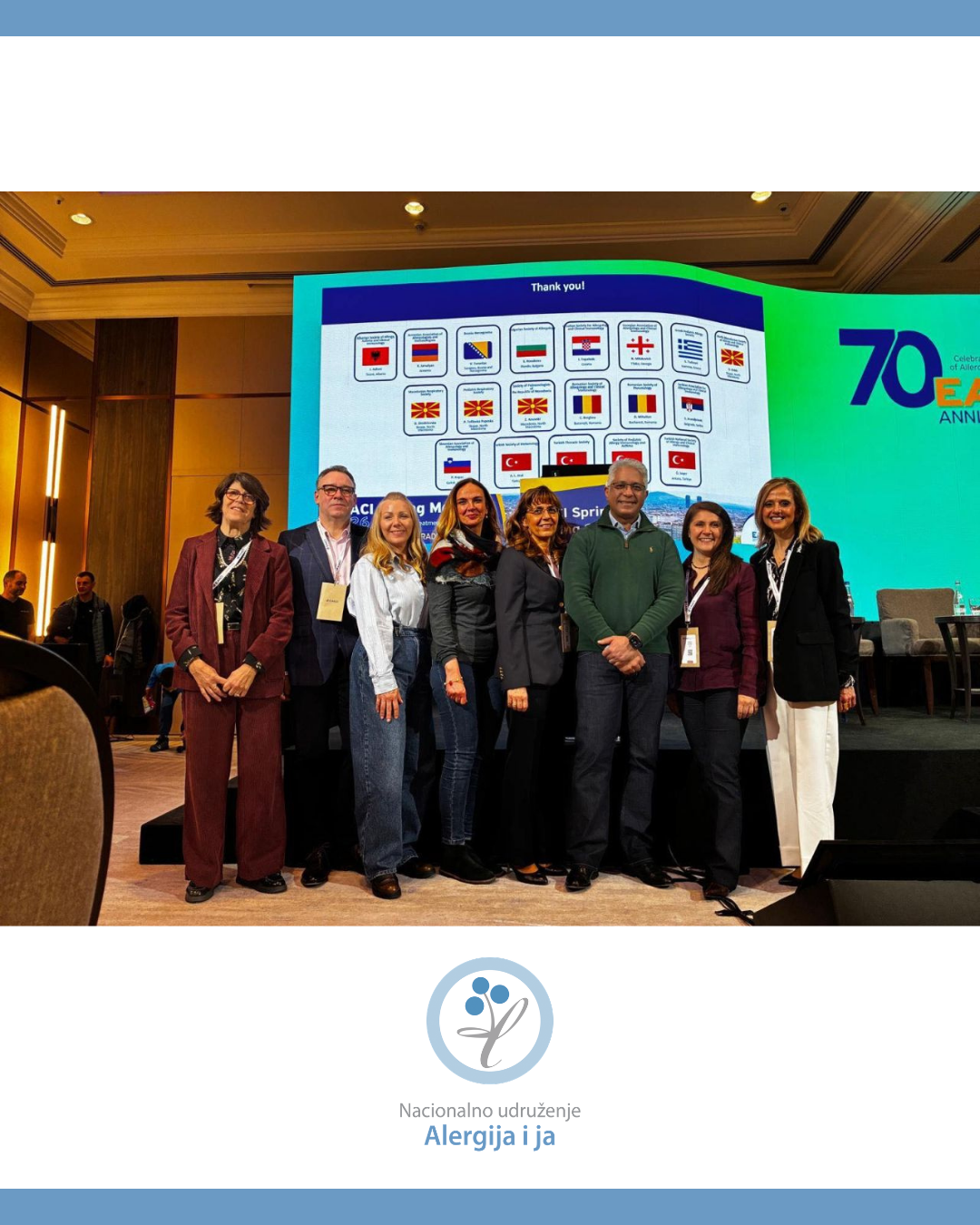

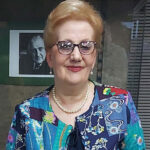
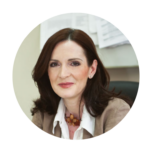
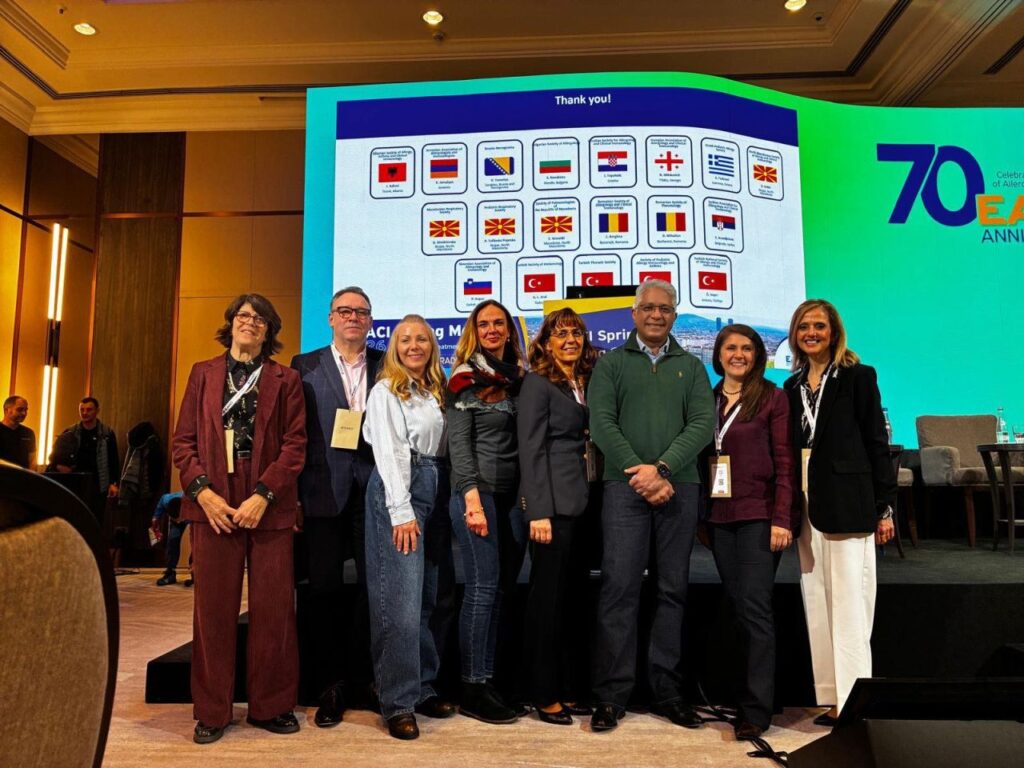
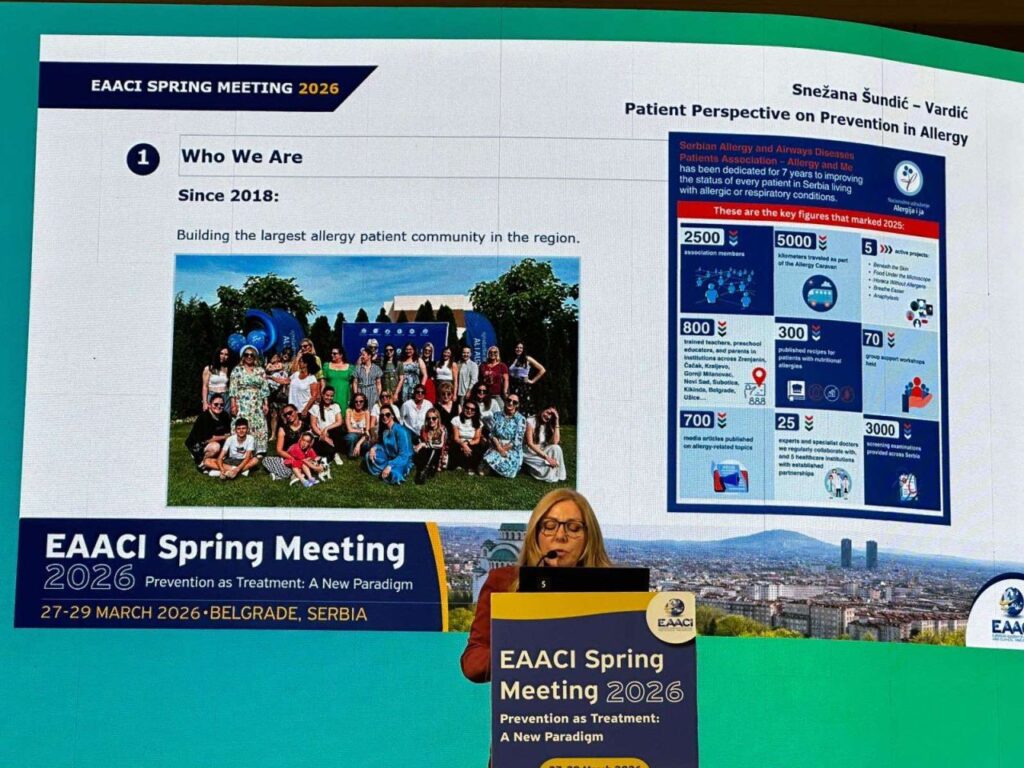
Predstavnica Nacionalnog udruženja „Alergija i ja“, Snežana Šundić – Vardić, učestvovala je na stručnom skupu u organizaciji European Academy of Allergy and Clinical Immunology (EAACI), jedne od vodećih evropskih organizacija u oblasti alergologije i kliničke imunologije. Tokom sesije posvećene perspektivi pacijenata, predstavljen je pogled zajednice osoba koje žive sa alergijskim oboljenjima i svakodnevnim izazovima sa kojima se susreću.
U fokusu izlaganja bili su problemi sa kojima se pacijenti suočavaju na putu do pravovremene i tačne dijagnoze, dostupnosti adekvatnog lečenja, kao i potreba za većim razumevanjem i podrškom u porodici, školi, radnom okruženju i društvu u celini. Posebno je istaknuto da alergijske bolesti značajno utiču na kvalitet života miliona ljudi, zbog čega je neophodno da glas pacijenata bude sastavni deo svih razgovora o zdravstvenim politikama, edukaciji i unapređenju zdravstvene zaštite.
Skup je još jednom potvrdio značaj uključivanja pacijenata u procese donošenja odluka i kreiranja zdravstvenih rešenja. Predstavnici udruženja pacijenata nisu samo korisnici zdravstvenog sistema, već važni partneri koji svojim iskustvom mogu doprineti boljem razumevanju potreba zajednice i razvoju efikasnijih modela podrške.
Posebnu vrednost događaju dalo je kontinuirano zalaganje stručnjaka i lidera u oblasti alergologije za aktivno uključivanje organizacija pacijenata u stručni dijalog, istraživanja i zagovaračke aktivnosti. Takav pristup omogućava da se iskustva ljudi koji žive sa alergijama i drugim hroničnim stanjima pretvore u konkretne inicijative koje vode ka dostupnijoj zdravstvenoj zaštiti, boljim pravima pacijenata i kvalitetnijem životu.
Za Nacionalno udruženje „Alergija i ja“, učešće na ovakvim međunarodnim skupovima predstavlja priliku da potrebe pacijenata iz Srbije budu predstavljene na evropskom nivou, ali i da se uspostave nova partnerstva i razmene iskustva sa organizacijama i stručnjacima iz različitih zemalja.
Pročitajte obraćanje predstavnice udruženja
U nastavku možete pogledati govor predsednice Nacionalnog udruženja „Alergija i ja“, u kojem je predstavljena perspektiva osoba koje žive sa alergijskim bolestima i značaj uključivanja pacijenata kao ravnopravnih partnera u kreiranju zdravstvenih politika, edukacije i sistema podrške.

Dear healthcare professionals,
Welcome to Belgrade — it is a true pleasure and privilege to have you here, gathered within the EAACI community.
We are deeply honored that this important meeting is taking place in our city.
I would like to sincerely thank EAACI President professor Maria Torres and
professor Marina Atanasković Marković for bringing EAACI to Belgrade
and I would like to give a special thanks to Özlem Ceylan from the Turkish patient organization and EAACI Patient Organization Committee for her commitment to patient involvement.
It is truly a privilege to be part of this community.
I would like to thank to all the panelists for their excellent presentations and especially Prof. Turkalj, whom I personally know, for her dedication to patients and her truly understanding of patients need.
When we talk about prevention in allergy, we often think about guidelines.
But for families living with allergic diseases, prevention is not a document.
It is a daily responsibility.
My name is Snežana Šundić Vardić, and I represent the Serbian Allergy and Airways Diseases Association Allergy and me.
I am communicologist, patient— and a mother of two children with severe allergies.
Our association focuses on supporting patients and families living with food allergies, anaphylaxis, atopic dermatitis, and asthma —
conditions that affect not only individuals, but entire families.
From the very beginning, our mission has been to raise awareness —
both in society and among patients themselves.
Because many patients live with symptoms for years
without fully understanding their condition,
without clear guidance,
and without the support they need.
And in such situations — prevention becomes very difficult.
Over the past 8 years, we have implemented lot of activities to support patients:
- national awareness campaigns on allergies and respiratory diseases
- educational platforms and patient publications
- free allergy counseling during the COVID period in collaboration with healthcare professionals
- tools and guidelines for schools and kindergartens
- practical resources and workshops…
We have also led initiatives in food allergy safety,
including education on food labeling and collaboration with the HoReCa sector.
In the post-COVID period, we organized accredited regional symposia for pediatricians
to strengthen knowledge in primary care.
We participated in more than 50 TV appearances per year,
and we continuously organize community events, workshops, and public discussions
where patients and healthcare professionals can meet and better understand each other.
But over time, we have learned something very important:
Awareness is only the first step.
Today, our focus is on building stronger collaboration with healthcare professionals.
Because guidelines alone are not enough.
They must be translated into real-life support for patients and families.
And that can only happen through partnership.
In theory, prevention is clearly defined: early diagnosis, avoidance of triggers, proper treatment, and monitoring.
But in reality, families often face something very different.
One of the biggest challenges in our region is the gap between guidelines and everyday practice.
Families often go through a long journey before receiving the correct diagnosis.
They meet different healthcare professionals,
and outside the field of allergy, understanding is often limited.
Symptoms may be underestimated or misunderstood —
and during that time, the patients lose trust.
From the patient perspective, this is where prevention begins to fail.
Another major challenge is access to treatment.
In Serbia, adrenaline auto-injectors are not widely available on prescription.
Access is limited and often depends on individual clinics,
thanks to the efforts of allergists and patient organizations.
Access to allergen immunotherapy is also limited
and not available to patients through public healthcare funding.
Many patients never reach this form of treatment.
When it comes to food allergies and atopic dermatitis, the situation is even more complex.
Advanced therapies, such as biological treatments and JAK inhibitors,
are not available for patients with severe atopic eczema.
Basic treatments, like emollients — which are part of standard care and medical protocol—
are fully paid out-of-pocket.
For many patients, these costs become overwhelming.
Somewhere they even pay for diagnosis.
So we must ask:
Can we really talk about prevention if families cannot access the care they need?
For patients, this creates insecurity and confusion.
Many do not even know what prevention should look like in practice.
And even when they do — it is often too difficult to implement.
This is the key challenge we must address.
Because prevention is not only about recommendations.
It is about what patients can actually do in real life.
Patients and caregivers live with prevention every day.
We read labels.
We advocate — in clinics, in schools, at work, in restaurants, in markets,
in everyday situations, in parks, on planes, on the street,
at birthdays and celebrations.
We monitor symptoms.
We manage environments.
We make decisions — constantly.
We carry the responsibility of prevention every single day.
But we cannot do it alone.
If we want to move from guidelines to reality,
we must support patients in practical ways.
This means:
- improving access to therapies
- strengthening education — not only for patients, but also for healthcare professionals outside allergy specialties
- and building stronger collaboration between patients and doctors
Because prevention is not a one-time intervention.
It is a continuous process that requires communication, trust, and shared responsibility.
As part of this commitment, our next step is very concrete.
On April 25th, marking the first National Atopic Eczema Day in Serbia,
we are organizing an educational event for primary healthcare professionals,
in collaboration with the dermatology association.
Because strengthening knowledge at the primary care level
is one of the key steps in making prevention a reality.
If we want effective prevention in allergic diseases,
we must look beyond the clinical setting.
We must understand how patients truly live with these conditions.
Because—
health is not built only in clinics.
It is built through knowledge, collaboration, and understanding
between patients, doctors, and the community.
And patients and families should not be seen only as recipients of care.
They are essential partners in making prevention a reality.
Thank you.